



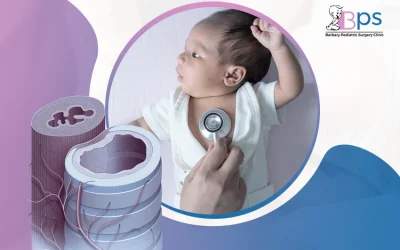
Commonly, a newborn infant may develop a tracheoesophageal fistula, which is an abnormal passageway connecting the two organs (Trachea and...
Esophageal atresia surgery for infants
Thyroglossal cyst in children and newborns (Also referred to as paediatric thyroglassal duct cyst) in one of the rare conditions that affect the...
The branchial cleft cyst is considered a birth defect that appears during the early fetal stages. And it appears after birth as a mass or pocket in...
The organs located in the abdominal region, such as the stomach and intestines, may rise into the chest cavity, putting pressure on the lungs and...
Social Media:

Esophageal atresia in infants and newborns is a rare birth anomaly affecting one in every 4,000 babies. This is diagnosed when the esophagus which connects the mouth to the stomach is divided into two separate parts instead of one.
Hence, the food does not pass naturally from the mouth to the stomach in the affected child, and they must undergo surgery to repair this defect. In this article, we discuss the surgery of such a case in details.
How does esophageal atresia for infants get treated?
The esophagus and trachea are formed as a single tube during the early embryonic stages, then separate so that each part grows independently. For unspecified reasons, the esophagus may develop as two separate tubes:
- The upper one is connected to the mouth,
- while the lower is connected to the stomach.
Such separate tubes become blocked from both ends.
And there is no treatment for esophageal atresia except surgical procedure to fix such anomaly in the trachea and to ensure restoring the connection between the mouth and the stomach.
Read about: Treating Transesophageal Fitsula
How is the esophageal atresia operation undergone?
The operation for infants starts by connecting the ends of both tubes together and disconnecting any unnatural connection between the trachea and esophagus while repairing both. The steps of the procedures depend on the types of anomalies that prevail in the infant’s digestive system.
Esophageal atresia surgery for infants is performed under general anesthesia, after which the child is placed in the intensive care unit for several days. It is likely that the child will remain in the hospital for several weeks. عملية انسداد المريء للرضع تحت التخدير الكلي ويوضع بعدها الطفل في وحدة العناية المركزة لعدة أيام، ومن المرجح أن يبقى الطفل في المستشفى لعدة أسابيع.
Learn more about: GERD in Infants
When is the child dispatched post operation after esophageal atresia surgery?
After esophageal atresia surgery for infants, the child receives feeding through a nasogastric tube: a thin, flexible tube passed from the nose through the esophagus and into the stomach. One week post operation, the surgeon examines the esophagus with an endoscope to ensure the healing state, and once healing is confirmed, the child begins feeding normally by mouth.
The child is discharged from the hospital when they can drink milk by mouth without issues and start showing signs of weight gain, meaning that the duration of the child’s hospital stay post surgery depends on their health condition and the speed of their recovery.
Is esophageal atresia surgery for infants considered an emergency surgery?
Esophageal atresia surgery for infants is not considered an emergency surgery, as it is performed several days after birth in most cases.
In rare cases, the surgery may be postponed for a few months if the distance between the two ends of the esophagus is long and cannot be connected to each other. The waiting period is to allow the esophagus to grow sufficiently so that the two ends can be connected together.
What are the complications of esophageal atresia surgery for newborns?
All surgeries carry the risk of complications to some extent, and for esophageal atresia surgery, the rate is low, but they should be known as a precaution. Complications of the surgery include:
- Bleeding
- Infection
- Re-narrowing of the affected part of the esophagus, and the recurrence of symptoms, which include the following:
- Difficulty Swallowing.
- Sharp coughing while breastfeeding.
- Vomiting.
- Choking.
- Refusal to feeding.
Therefore, if the child experiences any abnormal symptoms after the surgery, the treating physician should be consulted immediately.
Treatment of esophageal stricture in children in its final stage.
The infant undergoes some medical examinations to evaluate the condition of the esophagus if signs of narrowing appear after undergoing surgery to repair the atresia. Treatment of esophageal stricture at this stage requires endoscopic surgery to dilate it.
After esophageal atresia surgery for infants
The child may experience breathing difficulties, feeding problems, and growth delays after the surgery, and therefore requires special care and regular follow-up with the doctor to carefully monitor their condition, intervene when needed, and address any problems as they arise.
How much does esophageal atresia surgery for infants cost?
The cost of esophageal atresia surgery for infants can be determined based on the following factors:
- The child’s condition, the extent of the esophageal deformities, and whether they need other surgeries in addition to the operation.
- The tests the child underwent.
- The costs associated with the hospital at which the operation is being done.
- The duration of the stay of the infant in the incubator and the amount of care they required throughout such duration.
- The readiness of the incubator in which the child stays.
- The fee of the anesthesiologist and the assisting medical staff during the operation.
- The pediatric surgeon and their level of experience in esophageal atresia surgery.
Who is the most skilled paediatric surgeon to perform the esophageal atresia surgery?
Dr. Mohamed El-Barbary is considered one of the best pediatric surgeons for esophageal atresia surgery in infants. He is a professor and consultant of pediatric surgery at Abu El-Reesh University Hospital, a member of the Egyptian Pediatric Surgery Association, and has over 30 years of experience in pediatric surgeries.
In conclusion of our article, it can be said that esophageal atresia surgery for infants is the only solution to save a child suffering from congenital anomalies. We advise parents to quickly seek medical attention upon the appearance of any abnormal symptoms in the child that indicate esophageal atresia.
What is esophageal atresia in newborns?
Esophageal obstruction (esophageal atresia) is a rare congenital defect affecting one in every 4,000 babies, in which the esophagus is divided into two separate parts instead of a single continuous tube connecting the mouth to the stomach.
Is there any other treatment besides surgery?
No, surgery is the only treatment for esophageal atresia. The goal is to connect both ends of the esophagus together and close any abnormal fistula between the esophagus and the trachea.
Is esophageal atresia surgery an emergency surgery?
Esophageal atresia surgery in children and newborns is not considered an emergency surgery in most cases, as it is performed a few days after birth when the baby is in a stable condition. In rare cases, it may be postponed for months if the distance between the two ends of the esophagus is too large.
When is the baby discharged from the hospital after the surgery?
The baby’s feeding begins through a nasogastric tube, and after approximately a week, the surgeon examines the esophagus using an endoscope to ensure it has healed. Once confirmed, oral feeding begins. The child is discharged when they can drink milk normally and gain enough weight, which may take several weeks.
What are the possible complications after the esophageal atresia surgery?
Possible complications include: bleeding, infection, and re-narrowing of the esophagus (symptoms of which manifest as difficulty swallowing, coughing during feeding, vomiting, and choking while feeding). If the esophagus narrows, it is dilated using an endoscope.
What is the required care after esophageal atresia surgery?
The child requires special care and regular follow-up, as they may initially experience some difficulties with breathing and feeding. Prompt intervention upon the appearance of any abnormal symptoms is crucial.
Does the child suffer from swallowing difficulties after recovery?
Some children may experience a narrowing of the esophagus later on, which manifests as difficulty swallowing solid foods as they grow older. Therefore, periodic follow-up examinations are conducted, and if a narrowing is detected, it is treated by dilating the esophagus using an endoscope.
احجز موعدك
احصل على أفضل رعاية طبية لطفلك مع الدكتور Mohamed Elbarbary
بيانات الاستمارة: مثل الصفحة الرئيسية
بيانات الاستمارة: مثل الصفحة الرئيسية